
What Are We Crying For, If We Don’t Share That History or Language?
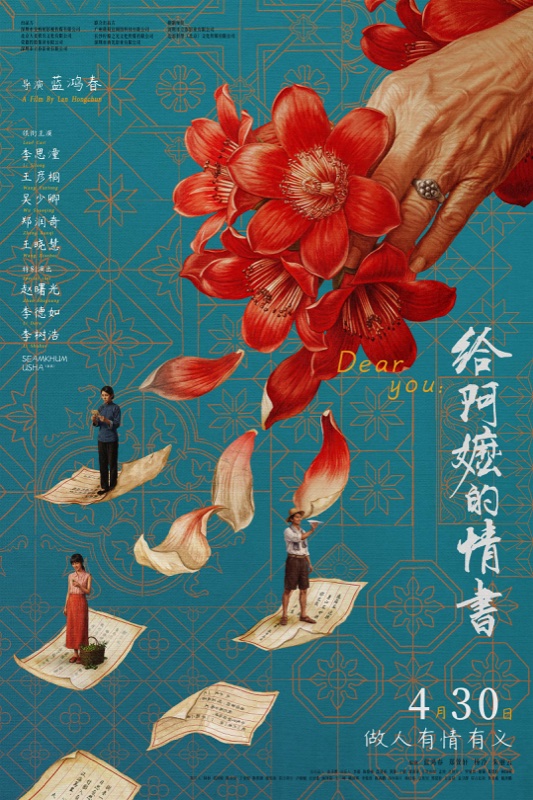
The relatively sparse theatrical release of Dear You outside Guangdong Province feels all the more lamentable after watching the film. I had already heard the praise surrounding it, but even with only the vaguest expectations, I found myself in no way disappointed. This is not a film that depends on regional identification to work. There are countless people in the world who have neither experienced nor even heard of that particular history. Words like qiaopi / 侨批—the letters and remittances sent home by overseas Chinese—and Tangshan / 唐山, once so deeply marked by their historical moment, have long since fallen out of everyday conversation. And yet the film still moves us. It still creates a resonance with people whose lives have never intersected with that era. That is not something that can be achieved simply by speaking Chaoshan dialect.
First of all, this is not a story that asks its audience to carry its historical weight.
The director never places that era, or the people who lived through it, upon us like a monument. It is only towards the end that people like Zheng Musheng and Ye Shurou, who have been quietly embedded in the story all along, are gradually brought forward from the folds of ordinary life to become visible in their own right.
Being moved by weighty history can itself feel heavy. When emotion comes burdened by historical significance, it can become solemn and difficult, making us reluctant to look back. In Dear You, however, history emerges organically through the lives of a few people. We are first moved by Ye Shurou and Xie Nanzhi, and then, through them, by countless others like them.
The stories of Ye Shurou, Xie Nanzhi, Zheng Musheng, and the others are also told with remarkable restraint and tenderness.
Zheng Musheng is destined to die. His death is presented from the very beginning as an established fact, a hook embedded in the story. The audience becomes curious about this “stranger who is destined to disappear,” and through his absence, we are gradually led into Xie Nanzhi’s life.
As the story slowly unfolds, two spaces begin to stand alongside each other. On one level, the film tells of the individual experiences of people living in Siam and those living in Chaoshan. On another, it evokes the collective memory of a generation: people in Siam looking towards their homeland, and people in their homeland looking towards Siam.
“Nation” is introduced into this structure, which is ultimately built around Renqing/人情—the human bonds of affection, obligation, and reciprocity—through very small, almost imperceptible details. It is like a beaten egg: you know there must be both egg white and yolk, but they have been mixed together. You neither need to separate them nor find their coexistence abrupt.
And so, “recreating history” is never the real center of the story.
The “love letter” becomes a concrete vessel through which emotion is deliberately made to arrive late, making absence itself feel natural and necessary. This delay, together with the coincidences that follow, allows emotions between different people to be repeatedly confirmed, deepened, and redefined.
There are no great twists or dramatic peaks in Dear You. What it has instead are countless small units of emotion. Within this particular historical landscape, the stories of those separated across two sides never point towards a conventional climax, nor do they seek catharsis. Instead, they persist with a quiet, enduring emotional force, flowing across generations—like the earth itself, carrying and nurturing everything that grows upon it.
So, what are we crying for, if we don’t share that history or language?
Dear You chooses an unusual story and gives us a group of people whose actions we are willing to believe in, using their lives to reveal the countless connections between human emotions. It does not ask its audience to enter that history, nor does it turn historical experience into a body of background knowledge that we are expected to learn.
Instead, it allows that history to reach us through emotion.
Through one specific story, it makes emotions and experiences that have long since passed into history once again perceptible—something we can feel, and something to which we can respond.