Lúcia Nagib: Cinema will survive all these deaths
Love, Death & Cinephilia: A Conversation with Lúcia Nagib
Cinema has been declared dead many times: with the arrival of sound, colour, television, digital technology, and now artificial intelligence. And yet, we are still here, watching, making, and talking about films.
But the “death” in Films to Die For by Lúcia Nagib is not only about cinema as a medium. It is also about the people who love cinema so deeply that they are willing to live, and even sometimes die, for it, and about films born from this devotion: films that remember other films, filmmakers who carry their cinephilia into creation, and artists for whom making films becomes inseparable from life itself.
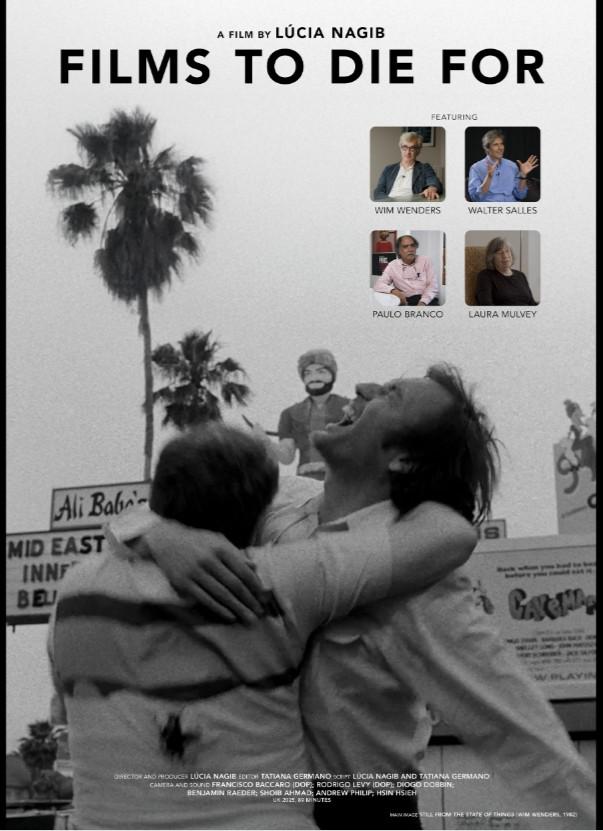
Beginning with Wim Wenders’s The State of Things, film scholar and filmmaker Lúcia Nagib traces these intertwined stories of cinephilia, creation, and death, connecting the fictional death of cinema with the real death of Brazilian filmmaker Glauber Rocha.
In this conversation, Hoho and Agnes as Cut2Thought speak with Nagib about what it means to love cinema, why she chose to make a film about films, the changing role of the spectator, Chinese cinema and women’s filmmaking, and how cinema might continue to live through all its supposed deaths.
The first question is about cinephilia. You describe cinephilia as a “love for cinema”, but also as a force that drives filmmaking itself. So for you, is cinephilia primarily a way of watching films, a creative impulse, or a way of forming relationships between people—just like us?
So cinephilia was not a concept until, I think, the 1950s. If you watch the film, you will see that Laura Mulvey says in those days when she became a cinefile, they didn’t call themselves cinephiles—they called themselves simply “movie fans.”
But the cinephilia became something important through the work of the Cahiers du Cinéma in France, where a number of then young critics in the Cahiers du Cinéma—including François Truffaut, Jean-Luc Godard, Éric Rohmer, Claude Chabrol, and many others who would later become filmmakers—started to write about the American films that were being produced at that time.
It was also a peak in production in the United States. And you have to understand that American cinema during the war was not distributed in France because France was under the command of the Nazi-collaborating government. So they didn’t have access to American cinema. And after the war, American cinema flooded the French market and cinemas, and the rest of Europe as well.
So they started to discover not just the films that were being produced in the United States in those days, but also the whole repertoire of the great classic American film. And they created a kind of pantheon of their favorite directors, including filmmakers such as John Ford; immigrant filmmakers like Fritz Lang, Billy Wilder; and other filmmakers, John Huston and Howard Hawks; and many other almost exclusively male filmmakers. And they started to cultivate—and Hitchcock, Alfred Hitchcock, who was elevated almost to the status of a god in filmmaking. And François Truffaut conducted a series of interviews with Hitchcock about each of his films and how he conceived each of them, and resulting in a famous book, Hitchcock/Truffaut.
And so that’s where that passion for cinema was elevated from a simple question of entertainment to a question of “high art.” So cinema was also elevated to the status of art; it wasn’t seen like that until then.
There was a whole discussion of whether cinema—being an industrial medium—could be equated to the other arts that were more author-driven, and you knew the artist that was behind it. But cinema had... was something made by a team of collaborators, and it wasn’t clear who the “author” was.
And the French critics defined the author of the film as the director, which was a big novelty. Authorship until then was attributed to the script writer, not to the director. So there were a number of changes, and from then on, this word—“cinephilia”—started to propagate and to become more popular.
And then, obviously, the meaning of “cinephilia” also expanded. And you see, you are those girls—beautiful girls there who support female filmmaking. And you also say that you are inspired by cinephilia. So this was not like that in the 1950s, so there was also a progress.
And in my film, Laura Mulvey—who is the creator, the founder of feminist film theory—she also describes herself as a cinephile. So the meaning of cinephilia expanded to encompass a number of different relationships between spectators and films.
But there is also, in my film, another expansion of the meaning of cinephilia, in which I presented as: cinephilia is embedded in films themselves—films that are in love with other films, films that contain other films, that connect with other films that are not... do not start from zero, but start from films that preceded them. And they are kind of combination, recombination, and also progression on the films that had been made before them.
So that is presented in my film as a kind of, let’s say, novelty and a new development—what cinephilia can mean. Thank you pretty much.
As we all know, you’re also a professor and you have published lots of articles and books. And so you could have written all of this as a book about Wenders and other filmmakers and cinephilia. And why did you ultimately choose to make a film rather than write another book? What can—like, in your opinion—cinema reveal about cinema that academic writing cannot?
Now filmmaking has become much more accessible to anyone—much more than it was in the past. The digital technology has made it much easier and cheaper to make film, and also to have access to films by others. So it’s very easy today for you to download a film and mix and match and cut pieces and recombine films.
So this has changed the kind of relationship that people used to have with cinema. And cinema used to be something distant from the spectator: you go to a screening room, you watch a film from 6:00 to 8:00 p.m., and you go home.
But since the introduction of digital technology... well, the relationship started to change with television. It was a change already, because cinema was brought to everybody’s homes. You could watch films at home and you could eat your sandwich; you could do other things while you were watching your films, right?
But another novelty was introduced with more sophistication of digital technology—first with the VHS tape, where people could stop and rewind and rewatch a scene, which was not available with television, where you had that slot of time: the film showed at that time, and that was it.
So at that moment, the spectator stops and becomes a “co-author” of the film, because you can recombine, you can stop, you can go slow, or you can fast forward. And this is not the way that the film was conceived originally, because every film is conceived to start and finish in a certain time.
So Laura Mulvey, again, is the person who first drew our attention to this change in spectatorship by conceiving the concept of “possessive spectator”—the spectator who contributes to the way that films are seen, and changes the way the films are seen, and interferes in the authorship of the film itself.
So you can discover things that you didn’t know before: by slowing down a scene, you can also repeat, you can bring other films to compare with that film. And technology is evolving more and more, and we can do all the time more and more. And with AI now, you can do whatever you want: you can imitate a film that doesn’t exist, you can imitate people who exist or don’t exist. So things are changing very quickly.
And we also had to change the way that we teach film, because all our students can make films as well. And so it became a form of assessment—alongside the traditional essay, alongside the traditional written exam, we also introduced video essays or videographic criticism, so that the students also have that medium, audiovisual medium, to present their knowledge on the subjects that you are talking about.
And I wrote a lot about Wenders and published about him and about many other things. But in the book form, the book page is flat—you can’t show all the scenes that you were talking about. And in the film, you have an argument, and then you can present the evidence inside the film; you can present, you can say that happens in a film, and then you can show to the spectator how it happens. And this is more convincing, in a way, than just writing about. So it’s another resource that became available to us.
On the other hand, you have to hide a little bit of the theory. The film medium is more of an entertainment, so if you start reciting all the theory that’s behind your thought, you will lead the spectator to fall asleep, and you don’t want that to happen. So you have to camouflage the theory, or you have to indicate only the theory and let the images speak louder than the theoretical concepts that you have—the images and the sounds, which are very important.
So it’s a very different medium. I don’t think that, for myself, film replaces the written word. But it’s a different, completely different way of communicating your ideas, and both of them equally valid.
And it’s out of my personal curiosity: would you enjoy yourself more on a book writing, or like films today for, like, filming—like for you personally?
All creative work is difficult: you go through many versions and you correct yourself, and you find your ideas—you progress with your ideas as you were making.
Filmmaking is a much less isolated activity than book writing. Filmmaking, you collaborate with a number of people. And in Films to Die For, as well as in my previous films, I collaborate in particular with my editor, Tatiana Chernova, who’s a great film editor. And so she has a lot of contribution in terms of authorship there too, because she has her own ideas that help me develop what I wanted to say—whereas writing is you and your computer in a very solitary situation. You obviously discuss ideas with your friends and colleagues, and you progress as you discuss, but it’s a more solitary activity.
Perhaps because of that, you have more liberty, more freedom to go wherever you want, and it’s just you, and it’s all your own responsibility.
So yeah, so there are these different aspects, and difficulties are everywhere, but both are very satisfying once it’s ready, once it’s done.
In order to prepare for this interview, we all read some of your books, including Realist Cinema as World Cinema, which was published in 2020. And in this film, you also started with Wim Wenders’s The State of Things—or also known as Der Stand der Dinge—as in this movie, Films to Die For. And our question is: why did you choose this specific film, The State of Things, as the starting point for your film, Films to Die For?
That’s a very good question. The title of my book is Realist Cinema as World Cinema: Non-Cinema, Intermedial Passages, Total Cinema. So there are three parts in the book: one is “non-cinema,” the middle one is “intermedial passages,” the last one is “total cinema.”
So The State of Things was the ideal film to get started with the book because it is a film that fails to happen—it’s a non-film. It’s the story of a film that could not be made, and so it’s the ideal example of non-cinema, of that kind of film that attempts to become film, but all the time is sent back to reality. And that’s why it’s also very realist in terms of drawing on a real situation of a film that has to stop because they ran out of film stock and money, and the producer has disappeared. So that was a real situation that inspired the film.
So in the film by Wim Wenders, which is a meta-film—a film about another film that couldn’t become a film—it also starts with a sci-fi that is in the making, but has to be interrupted because of the lack of film stock and also because of the disappearance of the producer. So at that point, there is a whole meditation about what filmmaking means: the relationship between Hollywood and Europe, the meaning of cinephilia, the change of times, the question of the medium itself. So it’s a total metaphor that helps us think about the frontiers between reality and illusion of it.
So I found it the ideal starting point to talk about non-cinema and the other film that I studied in that first part of my work, also around that subject of the blurred border between fiction and reality to the point that the film negates itself. So in Chapter 2, I talk about Jafar Panahi and his film, This Is Not a Film. Already from the title, you see that there is a questioning about what the film is, what it’s about, and the fact that he’s prohibited—that’s a very political film, because he had been banned from making films by the authorities in Iran, and so he had to disguise. He had to make a film pretending that he was not making a film, and so on and so forth.
So that’s why I started with them, The State of Things.
The State of Things is also in the poster of Films to Die For. And just as Agnes already said, that this film focused a lot on cinephilia, and we also notice that there’s another focus, which is death—specifically the death of films, or death in films about films. And in this film, the fictional meditation on death in Wenders’s The State of Things resonates so strongly with Glauber Rocha’s real death. And our question is: when did you realize that these two stories could be—or perhaps needed to be—connected? And also, did the discovery change the structure in the film?
Yeah, that was the starting point to have the idea of making this film. It was the real death of Glauber Rocha and the fact that he met the group making The State of Things in Sintra at that point and said in an interview to Patrick Bauchau—who was the lead actor in The State of Things—and saying on camera that incredible phrase, “Sintra is a beautiful place to die.”
And because I had already been studying the film by Wim Wenders, The State of Things, and I am very close to the whole work of Glauber Rocha because I wrote a lot about him too. I come from Brazil and Glauber Rocha is Brazilian. I already knew that story and how it connected with The State of Things. And the fact that filmmaking was so vital for Glauber Rocha, he couldn’t think about continuing to live without being able to make films.
So he had everything he had in his last film, which is called The Age of the Earth. He had even sold the house where his mother lived in order to fund the film and took the film to the Venice Film Festival. And it was a big disaster in critical terms, because the film was not understood in the way that he wanted it to be understood. It was dashed by the critics, and so there was no way that he would be able to raise funding for his next film. He had several projects in the future, so he went back to Portugal. He had been there during the Portuguese revolution in 1974, had strong links with Portugal. So he revisited Portugal at that point looking for solace, for some hopes of how he could continue. But his health was steadily deteriorating at that point, and so he was predicting that he wouldn’t survive for very long.
And in the series of letters that he wrote from Sintra, it’s very clear that he couldn’t see how he would continue to make films in Brazil—where he had created a lot of animosity against his own work—and also in Europe, the situation was very difficult for him.
So there is this beautiful moment where he accepts his own death and he says, “I am 42 years old and Che Guevara died when he was 38. I’m already 42, so it’s a lot for a Latin American person. So I’m not afraid to die. I traveled the world, I had all the women that I wanted to have, so it’s okay to die.” And it’s a very poignant moment. And it connects the death of cinema with real death, which was the point I wanted to make in the film.
Because actually my next question is connected with the saying from Glauber Rocha, “Sintra is a beautiful place to die.” And I originally want to ask, what’s this “death” or this “die” referring to, but I think you just answered that. Thank you very much.
There is also the fact that Patrick Bosso, who was a fan of Glauber Rocha and wanted to interview him there on the set of The State of Things. He was a friend of Laura Mulvey. She was developing as a film critic, but Patrick Bosso was the one who inspired her and her generation to turn to cinema.
Because Laura Mulvey was studying history in Oxford, and it was Patrick Bosso who took the volumes of the Cahiers du Cinéma—with that famous yellow cover—to Oxford and introduced his friends in Oxford to cinephilia. So that’s inspired by that kind of exchange with Patrick Bosso. They started to watch all those films, and then later they started to make films themselves.
So Laura Mulvey and Peter Wollen—and some of her films, Patrick Bosso appear in them as well: Crystal Gazing and Friendship’s Death. And most importantly, these films are very much focus on the question of death, of a hope, of a utopian hope, of change, social change with the election of Margaret Thatcher and the conservative turn in British politics.
So there is also the aspect of that in the films of Laura Mulvey that I show, that have that connection with Patrick Bosso as well. So there is intercrossing of several parts there, and the question of film significance that is cut across all of them.
We notice that your recent research has also turned towards Chinese cinema and the idea of “dying for art.” So do you see particular cultural differences in the way Chinese cinema imagines artistic death, the death of the artist, or the death of the cinema, compared with European or Latin American traditions?
I’m not a specialist in Chinese cinema—it’s something really big. I’m a big fan of some Chinese films, and I’m learning from Yixiang and learning from my Chinese PhD students as well.
There are some strands in the Chinese independent cinema that I find really very exciting, and I think that the theme of death also appears in several of these films that I’m looking at. And there are some sad cases: there is the case of An Elephant Sitting Still by Hu Bo, who committed suicide before the film was ready. And there are some interconnecting themes of suicide that I have developed in some other articles of mine, but there is also such a wonderful creative impetus in Chinese cinema.
And there is the commercial cinema that is something I don’t have much access to, because it doesn’t get distributed outside of China—it’s more internal to China, so I don’t have access in terms of subtitles and so on. But I’ve seen a number of films made by women, and that are very, incredibly creative and innovative.
And Yixiang runs the Mint Chinese Film Festival. So last year I had to watch a number of films because I was part of the jury and watched a number of the films that were placed there, and I saw how strong the question of identity is—female identity, gender identity as well—and how strong female filmmaking in China has become. So you are the example of it, so you are two specialists as well. So I’m really in awe of the work that you’ve been doing.
We both noticed and observed that the environment or the market of filmmaking these days is actually not as optimistic as we thought or as it used to be. And since you are both a film scholar who has spent years thinking and studying, researching about the element “death” in the film or off the film, and also a filmmaker of Films to Die For. So after making this film, how do you see the future of cinema? Do you still believe that cinema is dying—or have you come to see “death” as part of the way cinema survives and transforms itself?
Yeah, I think that’s very well put. It’s not the death—it’s the way the cinema survives through change.
Since the introduction of sound in the cinema, people have been announcing the death of cinema. And The State of Things also announces the death of cinema. Yeah, yeah, that has been repeated over and over again throughout the history of cinema. When sound was introduced, there was a host protested against it. They thought that it destroyed the essence of cinema that was images only, and that sound should be separated—should be played perhaps in the screening room, but should not be part of... so spoken dialogues that did not belong to the cinema. But then obviously people got used to it.
But then obviously there came color when color film came in. There was another way of protest, people saying color destroyed the beauty of black and white. And it’s very interesting that in this—The State of Things—question of color and black and white is also present, because Zinnemann wanted to make his film in black and white and was forced by Hollywood to make it in color when he was making A Man for All Seasons. So that is... that attachment to black and white was a more authentic form of cinema. And color, in a way, destroyed it, because at the beginning, color was felt as very artificial. And people took time to accustom their eyes with the colors that cinematic image presents, which are different from the colors that we see around us. Our eyes now got accustomed to identify the colors around us with the colors that we see in photographs and in movies. But they are different; they are not the same.
So every time a new technology is introduced, there is this outcry, and everybody saying, “Oh, cinema is going to die,” blah, blah. And when digital technology replaced the film strip, the celluloid—again, everybody said cinema is dead. And now with AI, again, cinema is dead: “We can just sit and tell AI to make a film of such and such thing, and we don’t even need reality to be copied.” But I don’t think these things really happening in that kind of catastrophic way. I think it’s just the changes that things go through.
And I think today you see people making films again on celluloid. And we just had Oppenheimer by Christopher Nolan on IMAX, yeah, and 70 millimeter film stock. So there are people who still prefer the other, traditional kind of material way of making films—for galleries, for example, are made with old technologies. And new technologies live alongside old technologies, so I think there is space for everything.
Going to the cinemas today is something very expensive. So my students cannot go to the cinemas because they don’t have money to pay for it, at least here in the UK. I don’t know in China how much it costs—here it is very expensive, so very few of them have the power, economic power to afford going to the movies. But they can watch all sorts of things on their computers, on their phones, and so there is more access in that kind of way.
But what I feel is losing—is getting lost—is the collective appreciation of cinema, being in the room with lots of people. But I don’t think this is the end. I think it’s the beginning of something new.
And I think that cinema will survive all these deaths.