
Between Father and Daughter, Between Life and Film
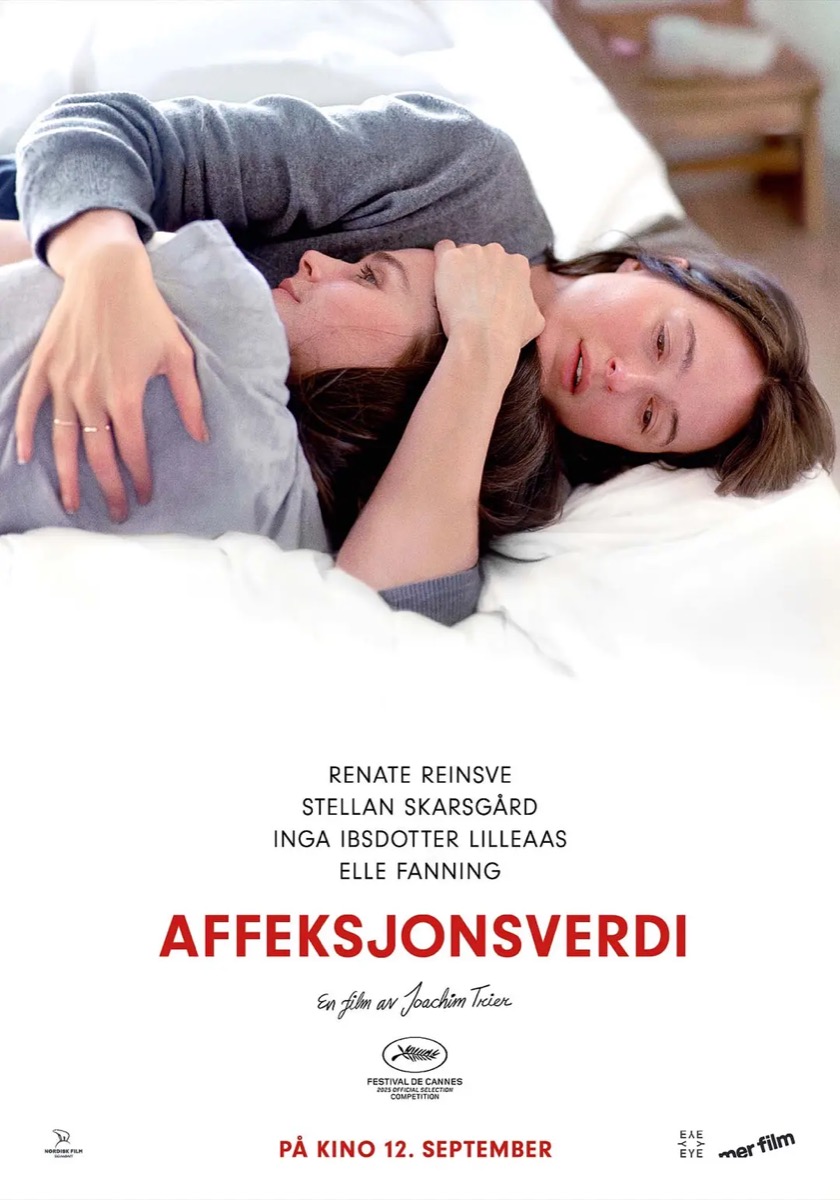
Directed by Norwegian filmmaker Joachim Trier, Sentimental Value arrived in mainland Chinese cinemas in 2026 after a successful festival run marked by major nominations and awards. Though rooted in a distinctly Norwegian context, the film builds its emotional resonance on experiences that are remarkably universal, reaching across cultural boundaries. Rather than focusing solely on the existential predicament of the individual, Trier turns his attention to something more intimate and enduring: the structures of family and the fractures that emerge between generations.
This universality has also been reflected in the film’s international reception. Sentimental Value premiered in competition at the Cannes Film Festival in May last year, where it received a 19-minute standing ovation and won the Grand Prix at the 78th Cannes Film Festival. It subsequently received several major honors at the European Film Awards before winning Best International Feature Film at the 98th Academy Awards, becoming the first Norwegian film to receive the award. The film was also recognized with nominations and accolades at major awards including the Golden Globes and the BAFTAs, earning a broad international audience and successfully moving from the relatively contained sphere of arthouse cinema into the wider public consciousness.
Within contemporary Nordic cinema, Joachim Trier has long been a filmmaker particularly attuned to the structures of emotion. His so-called “Oslo Trilogy”—Reprise, Oslo, August 31st, and The Worst Person in the World—centers on social alienation and crises of identity, gradually establishing his position within European auteur cinema. All three films were co-written and directed by Trier and Eskil Vogt, following intelligent yet deeply self-doubting characters from Oslo’s middle class as they grapple with memory, identity, and the passage of time.
From the “Oslo Trilogy” to Sentimental Value, now reaching Chinese cinemas in 2026, Trier has continued to dissect the emotional dilemmas of modern individuals, translating private experiences into cinematic forms with a wider resonance.
Alienation has often served as an emotional lens through which Trier’s films are experienced. If The Worst Person in the World focuses primarily on the contemporary urban subject’s sense of self-loss, Sentimental Value moves further inward, toward family memory and intergenerational trauma: the emotional rupture between an aging filmmaker and his two daughters.
Cinema itself is given a distinctive function within the film. The father, once a celebrated director, has remained estranged from the practical affairs of his family for years. He attempts to repair his relationship with his two daughters by making a film based on the experiences of several members of the family. Through filmmaking, he seeks to process real-life trauma through art, substituting cinematic construction for direct communication and transforming emotions that cannot be articulated into narrative material that can be written, organized, performed, edited, and controlled. Cinema, therefore, is not merely the film’s overarching narrative device; it also becomes both an object of narration and an instrument through which the narrative unfolds.
Yet perhaps the most intriguing aspect of Sentimental Value lies in its subtle dialogue with the tradition of Ingmar Bergman. As The Hollywood Reporter’s Pete Hammond observed, this may be Trier’s closest approach to the kind of human conflict that Bergman explored, suggesting that Bergman’s cinema has either influenced Trier or, at the very least, served as a source of inspiration.
The homage may first be noticed at the level of form. A sequence in which the faces of the father and his two daughters intersect and merge directly recalls the iconic imagery of fused faces in Bergman’s Persona. As individual boundaries begin to dissolve, identity and emotion seem to encroach upon one another, giving an otherwise intangible psychological process a strikingly visual form.
But Trier’s engagement with Bergman goes beyond stylistic imitation. It extends to a similarly psychological mode of storytelling. In their treatment of interpersonal relationships, Trier and screenwriter Eskil Vogt follow a distinctly Bergmanesque path of psychological excavation, particularly in their examination of the father-daughter relationship. Silence, avoidance, and misinterpretation form the basic mechanisms of conflict. At the same time, the father’s attempt to re-enter his daughters’ emotional worlds through a film script introduces a new dimension to this dynamic. The premise continues Bergman’s longstanding concern with the difficulty of expression, while offering a gentler—but by no means uncomplicated—possibility of escape.
Sentimental Value does not build its drama around overt confrontation. Instead, it accumulates through small emotional shifts. Its characters rarely erupt; they evade, postpone, and misunderstand one another. It is precisely these emotions left unspoken that form the film’s true dramatic core. In this sense, Sentimental Value is both a response to the Bergmanesque tradition and a careful, self-conscious departure from it.
The performances further enrich the film’s emotional register. Renate Reinsve, who left a particularly strong impression in The Worst Person in the World, is especially compelling as Nora Borg. Film critic Johnny Oleksinski wrote in the California Post that audiences will find themselves drawn to her “even if they can’t quite say why.”
What makes Sentimental Value worth recommending is not that it offers a definitive answer to the question of emotion, but that it captures with remarkable precision why emotion is so difficult to measure in the first place. In Trier’s cinema, family is not necessarily a place of belonging, but a network of relationships that must continually be understood and repaired. From Bergman to Trier, Nordic cinema has continued to return to a fundamental question: how can human beings establish—or restore—genuine connections with one another?
Whether the father and daughters truly achieve reconciliation by the end of the film may remain open to interpretation. But Sentimental Value seems to suggest that the answer may lie not in finally understanding one another, but in the act of continuing to try.